History will be kind to me for I intend to write it. -Winston Churchill

Wednesday, July 16, 2014

Spies Be Warned


Well, Marin is back to tell you all another story. So come on with us and we’ll take you down the battlefields of the South, where we accidently cause more trouble than we meant to…

            It really isn’t ladylike for an eleven-year-old girl to stand on the battlefields with a whole bunch of officers while they discuss battle tactics and plans. No, not my cup of tea. Even more unladylike is to offer advice to the commanders on how they could best win their battle. Believe me, if I hadn’t been asked I wouldn’t have answered.
            What was the final straw for me was the fact Trevor insisted I wear a boy’s uniform.
            “It would probably be best,” he explained. “They wouldn’t let you on the field with me if they knew you were a girl.”
            I coaxed, I begged, I pleaded. “Trevor, I’m a Czech girl from Czechoslovakia during the 1930s. Until I met you I’d never worn trousers in my life. I like my skirts, I like my dresses, I like my traditional wear. I understand having to wear disguises when we travel to a different time period.” I then motioned to the white bonnet and yellow cotton dress I’d picked out. “I’ve got this nice Civil War era dress all picked out. But now you’re asking me to pretend I’m a boy and wear a boy’s army uniform and act like I’m in the army? An all male boy outfit? Ptáte se moc! You ask too much!”
            He frowned and crossed his arms. “Marin, do you want to come with me or not?” he’d huffed. “Because I’m going, with or without you.”
            Trevor was not going to budge and I knew it. Either get left behind or come along.
            And I went. Begrudgingly, yes, but I did come along. I couldn’t bear the thought of being on the island by myself for a couple days, so I agreed to his terms.
            That’s how I found myself in the retched drummer boy’s uniform, standing at Trevor’s side while he talked with the Majors. Trevor had decided it would be fun to outrank the other officers, thus he’d gone and gotten a hold of a Colonel’s uniform. Yes. He really was pretending he was a Colonel in the Union Army. And a Scottish one at that!
            It shocked me to watch the three Majors listen to him in rapt attention. They don’t even question his accent, they obey the uniform, I thought as Trevor outlaid his idea for the next battle. It didn’t seem to bother them that he was Scottish, all that mattered to them was rank. And under the laws of rank, Trevor was over them and had the right to suggest thoughts on their strategic moves for the next battle. Which happened to be Gettysburg. Fantastic.
            “Okay, here’s the thing,” Trevor was saying, his eyebrows arched as they studied a map a private had brought. “General Lee’s going to be barraging you from this direction,” he pointed to a corner of the map, “and he’s going to really push you right over here. Now, what you need to do is…”
            I sighed and rubbed my cheek. Great going Trevor, you who said we can’t meddle in history. Trevor was never one to follow the rules, even if he made them up. I frowned and rubbed my cheek again, glaring at the smudge that was left on my thumb. Trevor had dirtied my face so it was less obvious I didn't look exactly boyish.
            “Okay chaps, I think that’s it.” I jerked myself to attention as Trevor clapped his hands together and rubbed them vigorously. “That oughta keep General Lee on his toes!”
            “Thank you, Colonel,” Major Teton said, saluting Trevor. The other two Majors followed suit and Trevor saluted them back.
            “No problemo. Catch you later!”
            “Trevor,” I hissed as we walked away, leaving the Majors with confused looks. “Modern phrases?”
            Trevor patted me on the back and winked. “You worry too much. Relax and have fun! Please?”
            He was right. It was in my very nature to worry about Trevor’s antics. It was hard for me to lighten up, my past had taught me to never trust anyone and always avoid attention. Trevor was the exact opposite of me, he liked all he met and loved attention. Lots of attention.
            Blam! Someone ran right into me, knocking me onto the ground- and my hat off my head.
            Oui!” I cried. I snatched the hat and stuffed my blond braids back in, hoping no one had seen the strange hair of a supposed drummer boy. “Dobrota! Watch where you’re going, please!”
            The face that met mine told me my assailant was probably only seventeen or so. His brown eyes were wide and his long face in a sweat. He looks terrified, I thought.
            Then I remembered why.
            Trevor stood right behind me and helped me get up, the boy’s eyes never leaving the supposed Colonel’s.
            “What’s the hurry mate?” Trevor asked. “Somethin’ wrong?”
            “Uhhh, well, uhh,” the boy stammered. His blue uniform was dirty and his face streaked with mud. He came to his senses and saluted Trevor, stiffening up like a soldier. “Forgive me Colonel!”
            Trevor waved it off. “It’s fine, lad. Marcus is no worse for the wear, aye boy?”
            I tried not to grimace at my undercover name. I liked Marin so much better. “I’m fine,” I said. I glanced at the boy. “What’s wrong though? You look like someone’s chasing you.”
            At this his face went white and he took a step back. “I, I,”
            “No doubt he’s late to deliver a message to General George Meade,” Trevor interrupted.
            The Union boy nodded, his face relaxing as he wiped his brow. “That’s exactly it, and I’m very late!”
            Trevor pursed his lips together. “Hmmm…” he turned around and motioned a cavalry officer over. “You there! Come here!”
            No one dared disobey a Colonel, not even one who wasn’t in the same infantry. The cavalry Sergeant with the bushy mustache trotted over to Trevor and saluted. “Yes, sir?”
            “Let this laddie borrow a horse from you, he’s got a message to deliver to General Meade,” Trevor told him.
            The kid’s face brightened and he nodded eagerly. “Thank you, Colonel!” he exclaimed.
            The cavalry officer wasted no time, he led a tall and lanky bay Thoroughbred over, already saddled and bridled. “Will this do?” he asked the boy.
            “Fine, thanks.” The young man mounted onto the back of the horse and grinned down at Trevor and I. “Thank you Colonel, the war effort needs more understanding men like you.”
            Trevor was swelling with pride, I could tell. He simply smiled and waved the lad off. “Go on with ye then, don’t be late!”
            With one more salute, the boy cantered away on the bay, leaving us behind in a hurry.
            “You okay Marin?” Trevor asked, turning to me. “He really mowed you down there.”
            “I am fine, thanks though.” I sighed and stretched my arms. “Well, how are you enjoying ordering people around, Colonel?
            Trevor laughed as we meandered our way through the tents and camps of the Union army, soldiers milling around everywhere. The Pennsylvanian sun shone down on our backs and I yawned. “I’m loving this, don’t you just love living history instead of reading about it?”
            I opened my mouth to reply when a shout reached our ears. “Has anyone seen a seventeen-eighteenish boy with black hair and brown eyes run by?” a Sergeant shot past us, panting as he yelled. “Anyone?”
            “I did!” Trevor called out.
            The Sergeant braked to a stop, noted Trevor’s rank and saluted. “Which way did he go, Colonel?”
            “I just sent him off on a horse, he said he had a message for General Meade,” Trevor replied. “You need him for something?”
            The Sergeant’s face went starch white. He put his hand to his heart and moaned. “He’s on a horse?” he fell back and sat on a stump, his eyes wide and his hands shaking. “You sent him off on a horse? We’ll never catch him now!”
            Trevor and I exchanged glances. “What’s wrong?” Trevor demanded.
            “No disrespect meant, Colonel,” the Sergeant began. “But that boy you helped is a confederate spy, and he just stole General Meade’s strategic plans for the next battle.”

Excited? We hope so! Come back next week for part two!

Wednesday, July 9, 2014

Civil Finds: Book Recommendations on the Civil War


Once more we had to really think to pick out just three favorite books/series about the Civil War. There are hundreds of books on the Civil War, good and bad. We prefer to stick to the more Christian based/clean ones though, but if you want to get into the real thick of Civil War history you may want to check your local library for classics like The Red Badge of Courage (which does have a lot of swearing in it) or Across Five Aprils, a very good book about a family during the Civil War. Whatever your reading level or genre, you can bet there’s a book out there to suite you! These are just our top favorites. We hope you like them!


Rifles for Watie
By Harold Keith
Young Jeff Bussy was probably the only soldier in the West to see the Civil War from both sides and live to tell about it. Amid the roar of cannon and the swish of flying lead, Jeff learned what it meant to fight in battle. He learned how it felt never to have enough to eat, to forage for his food or starve. He saw the green fields of Kansas and Oklahoma laid waste by Watie's raiding parties, homes gutted, precious corn deliberately uprooted. He marched endlessly across parched, hot land, through mud and slash-ing rain, always hungry, always dirty and dog-tired. And through it all, he made friends and enemies, people who would change his very life and his view of the war.
What we like about this book: This book is very unusual in many areas. It not only shows both sides of the war but it has a whole cast of colorful characters and depicts the soldiers as men who were fighting for their country-- Whether Southern or Northern. It’s also got some great adventure in it, so hang onto your hats!
Age Range: 12 and up
Audience: Boys, but girls would like this book, too.
Cautions: There is war violence in some areas, and we don’t remember if there was any bad words in it. Reader discretion advised, depending on what your parents are okay with you reading. The story may be too intense for young readers, as the writer is a master in the craftsmanship of suspense, with a frightening chase scene and a couple others that may frighten young kids.
Era: 1861-1865
Special Notes: This is probably one of the best Civil War books we’ve ever read. It’s witty, it’s funny, and it had a great story to it. The plot twists leave you on the edge of your seat and the author gives a good view of both sides of the war.


Addy: an American Girl *
Meet Addy
Addy Learns a Lesson
Addy’s Surprise
Happy Birthday, Addy!
Addy Saves the Day
Changes for Addy
Author: American Girl and Connie Porter
Addy Walker's family is planning a dangerous escape from slavery in the summer of 1864. But before they can make the escape, the worst happens-- Master Stevens decides to sell some of his slaves, including Poppa and Addy's brother, Sam. Addy and Momma take the terrible risk of escaping by themselves, hoping that the family eventually will be together again in Philadelphia. Set during America's own struggle over slavery, the Civil War, Addy's story is one of great courage and love-- love of family and love of freedom.
What we like about this series: These books are cute and great for young girls who want to read a story about the Civil War without a lot of war violence involved. Addy is a very sweet character and quite likeable, one of the better American Girl characters.
Age Range: 9-14
Audience: Girls
Cautions: May be a bit scary for young readers, as the slave masters are brutal and vicious.
Era: 1864-1865
Special Notes: None.
* These are the ones we’ve read, there are more


Daria’s Discovery
By Norma Jean Lutz
Daria Fisk's father is a doctor who's serving with the Union Army. When her financially-strapped mother must open their home to boarders, a wounded soldier comes to stay. Daria's twin brother, David, is thrilled by the man's stories of war, but Daria has her suspicions. Daria Solves a Mystery uses actual historical events to tell the exciting fictional story of an eleven-year-old girl caught up in the confusion and drama of America's Civil War, and shows that anyone-no matter how young or seemingly insignificant-can make a difference. Melding fiction with real events is ideal for teaching history and faith!
What we like about this book: This has real adventure in it, the kind you kids like. There’s danger for Daria and her brother and you never know where it’s going to come from! Also, they’re written from a Christian perspective and Daria is slowly learning what it means to grow to be a young Christian lady.
Age Range: 9-16
Audience: Girls, but boys would like this book, too.
Cautions: Young readers may be scared by one of the scenes that takes place later in the book. Though the outcome is good, it may be a little too intense for little kids.
Era: 1862
Special Notes: None.

                Join us next week when we take a trip to the battlefront-- and almost let a costly mistake change the outcome of the war!

Wednesday, July 2, 2014

A Country Divided: America and the Civil War


            The Civil War. We’ve all read about it, heard about it, seen movies, TV shows and pictures of it. If asked, most people would explain that the Civil War was a war to free slaves in the South and abolish slavery.
            Part of it, but not all of it.
            The American Civil War, also known as the Great Rebellion, the War Between States, or the War of Southern Independence, broke out on April 12, 1861 and didn’t end until May 26, 1865. The start of the war was sparked by a Confederate General named P. G. T. Beauregard, who was given orders to open fire on Fort Sumter in Charleston Harbor, South Carolina. The end came when General Robert E. Lee from the South decided the bloodshed was needless and surrendered himself and his officers.
            Today we’re going to do something a little different. We’re going to focus on what caused the Civil War.
            The chief and immediate cause of the war was, yes, slavery. Southern states, including the 11 states that would later form the Confederacy, depended on slavery to support their economy. Southerners used slave labor to produce crops, especially cotton. Although slavery was illegal in the Northern states, only a small proportion of the Northern folk actively opposed it. The main debate between the North and the South before the war was whether slavery should be permitted in the Western territories recently acquired during the Mexican War (1846-1848), including New Mexico, part of California, and Utah. Opponents of slavery were concerned about its expansion, in part because they did not want to compete against slave labor. They made a living paying people, if the South got the Western territories signed on as slave states, then the Northerners would be out of business. Slave owners didn’t have to pay their employees. They owned their employees.
            By 1860, the North and the South had developed into two very different regions. Divergent social, economic, and political points of view, dating from colonial times, gradually drove the two sections farther and farther apart. Each tried to impose its point of view on the country as a whole. Although compromises had kept the Union together for many years, in 1860 the situation was explosive. The election of Abraham Lincoln as President was viewed by the South as a threat to slavery and ignited the war.
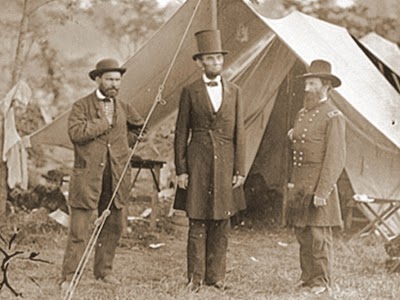
A picture of President Abraham Lincoln during the Civil War.
During the first half of the 19th century, economic differences between the regions also increased. By 1860 cotton was the chief crop of the South, and it represented 57% of all U.S. exports. Don't get bored here, this is important stuff! Especially because of what we're going to deal with later on this month. Ahem, anyways...
The profitability of cotton, known as King Cotton, completed the South’s dependence on the plantation system and its essential need, slavery.
The North was by then firmly established as an industrial society. Labor was needed, but not slave labor. Immigration was encouraged. Immigrants from Europe worked in factories, built the railroads of the North, and settled the West. Very few settled in the South.
As a result, although both the South and the West were agricultural, the West allied itself with the Northern, rather than the Southern, point of view. Economic needs sharpened sectional differences, adding to the hostility between the states.
            In short, the country was heading towards war, though they wanted to avoid it as much as they could. The final straw came when Abraham Lincoln was elected President.
            The South had threatened to succeed (leave the United States to make their own country) from the United States if Lincoln was elected. “The man is a threat to our very wellbeing,” they declared. It was well known that the Republican President was against slavery, the plantation owners were afraid he’d abolish slavery if he was elected.
A Map of the Civil War, showing what states were Confederate, Union or neutral.

            No one actually believed the South would succeed, so it was with shock the Northern states were informed South Carolina was leaving the Union only a week or so after Lincoln won the election. The convention the leaders in South Carolina held unanimously passed an ordinance dissolving “the union now subsisting between South Carolina and other States.” Similar meetings were held by other Southern states, and similar stands were taken, although not by unanimous votes. The first states to follow South Carolina’s course in 1861 were: Mississippi, January 9; Florida, January 10; Alabama, January 11; Georgia, January 19; Louisiana, January 26; and Texas, February 1. The North stood by in stunned silence as their neighbors and friends left them one by one. Everyone knew it was the beginning of war.
In April, President Lincoln called for states to send militias for national service to suppress the rebellion of the Southern states. They couldn’t just leave the United States, that’s what made America, well, the United States! The upper South refused to send their militias to stop the seceded states. Instead they joined the lower South in secession beginning with Virginia on April 17th; Arkansas, May 6; North Carolina, May 20; and Tennessee, June 8.
As the Southern states seceded, they seized and occupied most of the army forts within their borders or off their shores. Only four remained in the hands of the Union. Fort Sumter stood guard in the mouth of the harbor of Charleston, South Carolina. The other three forts were in Florida. Fort Jefferson in the Dry Tortugas, Fort Pickens in Pensacola Bay, and Fort Taylor at Key West. Of the four, Sumter was the most important.
            That’s where General Beauregard comes in. He was given orders to take Fort Sumter, thus starting the Civil War as the first shots were fired in the month of April. The Northerners were infuriated by what the Southerners had done and demanded action. President Lincoln gave it to them, ordering on April 15 a proclamation that called up a total of 75,000 militia from the states. At the same time, calls for troops were sent to the governors of all states that had remained in the Union. On April 19 a second proclamation announced that Southern ports would be blockaded. A third proclamation, dated May 3, called for 42,000 three-year volunteers for the regular army and for 18,000 volunteers to serve one to three years in the navy.
            The War had begun.
            This is where most of your history books pick up. They detail about battles such as Bull Run, Shiloh, Gettysburg and Antietam. And of course we all know that when the war came to an end in 1865, Lincoln was shot not more than six days later by a crazed actor who had sworn his allegiance to the Confederacy. 
The flags of the South and the North.
            Yes, I know, I’m skipping over the main part of the war. I don’t think you need an overview on that. Why? Because I think what’s important here is to realize why the war happened. From all the information I’ve given you, what’s your conclusion? Why did Americans fight other Americans? Why is there still so much controversy on the Civil War today?
            Here are some points that I think are important.

            1. Greed. The South wanted to increase their production and money without having to pay employees. The North was afraid of being pushed out of business by the South and thus wanted slavery abolished. Both sides were in the wrong in that area.

            2. Politics. Southern and Northern politics were vastly different, not only on the matters of freedom vs. slavery but on other matters. The North needed a central government to build its roads and railways, protect its trading and financial interests, and control the national currency. The South depended much less on the federal government than did other regions, and Southerners therefore felt no need to strengthen it. In addition, Southern patriots feared that a strong central government might interfere with their way of life, particularly slavery. Sounds kinda like our politicians today, huh?

            3. Mindset. This is a very important point. Mindset is everything. Not all slave owners were bad, some of them treated their slaves very well and cared for them. And not all Northerners were good. What about those factory owners who employed children on such low wages and horrible working conditions that many of them died? Mindset is the way we think. A lot of very good Southerners simply supported the South because they were from there, they were loyal to their Southern heritage. It was their mindset, this was who they were. Cut dry and simple, yes, slavery is wrong. Yes, it needed to be abolished. But the war was more technical than that. It was a lot of things put together that caused it.

             Today there is still a lot of Southern vs. Northern attitudes. Again, that’s mindset. Thank goodness most of us have come to terms with the past, but there are still some people who get angry about the Civil War and the outcome. In all honesty that’s sad.
            The Civil War is a big part of American history, and I know as a fact you’ve all read about it. But sometimes history isn’t about the actual event, it’s about the events that led to the big clash. In the case of the Great Rebellion, sometimes disputes between brothers are worse than disputes between neighbors. We lost more Americans in that war than any other war we’ve been in since. Slavery was abolished, but not without a great price of blood, brotherhood and friendship.
            Special thanks to Microsoft ® Encarta ® Reference Library 2005. If you want to read more facts about the Civil War in great detail, this is the program to use.

            Little Known Fact: Did you know that one-third of the soldiers who fought for the Union Army were immigrants, and nearly one in every ten soldiers was African American? This was because the North was where most people from other countries moved to when they came to America.

Today in History: Today was the second day in the battle of Gettysburg in 1863. General Robert E. Lee was so far winning the battle and was determined to further his success of the previous day's fighting. The battle took place in Peach Orchard, Pennsylvania.

Come back next week when we give you some great books to read on the Civil War!