History will be kind to me for I intend to write it. -Winston Churchill

Wednesday, July 2, 2014

A Country Divided: America and the Civil War


            The Civil War. We’ve all read about it, heard about it, seen movies, TV shows and pictures of it. If asked, most people would explain that the Civil War was a war to free slaves in the South and abolish slavery.
            Part of it, but not all of it.
            The American Civil War, also known as the Great Rebellion, the War Between States, or the War of Southern Independence, broke out on April 12, 1861 and didn’t end until May 26, 1865. The start of the war was sparked by a Confederate General named P. G. T. Beauregard, who was given orders to open fire on Fort Sumter in Charleston Harbor, South Carolina. The end came when General Robert E. Lee from the South decided the bloodshed was needless and surrendered himself and his officers.
            Today we’re going to do something a little different. We’re going to focus on what caused the Civil War.
            The chief and immediate cause of the war was, yes, slavery. Southern states, including the 11 states that would later form the Confederacy, depended on slavery to support their economy. Southerners used slave labor to produce crops, especially cotton. Although slavery was illegal in the Northern states, only a small proportion of the Northern folk actively opposed it. The main debate between the North and the South before the war was whether slavery should be permitted in the Western territories recently acquired during the Mexican War (1846-1848), including New Mexico, part of California, and Utah. Opponents of slavery were concerned about its expansion, in part because they did not want to compete against slave labor. They made a living paying people, if the South got the Western territories signed on as slave states, then the Northerners would be out of business. Slave owners didn’t have to pay their employees. They owned their employees.
            By 1860, the North and the South had developed into two very different regions. Divergent social, economic, and political points of view, dating from colonial times, gradually drove the two sections farther and farther apart. Each tried to impose its point of view on the country as a whole. Although compromises had kept the Union together for many years, in 1860 the situation was explosive. The election of Abraham Lincoln as President was viewed by the South as a threat to slavery and ignited the war.
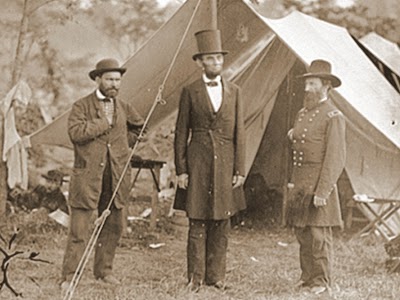
A picture of President Abraham Lincoln during the Civil War.
During the first half of the 19th century, economic differences between the regions also increased. By 1860 cotton was the chief crop of the South, and it represented 57% of all U.S. exports. Don't get bored here, this is important stuff! Especially because of what we're going to deal with later on this month. Ahem, anyways...
The profitability of cotton, known as King Cotton, completed the South’s dependence on the plantation system and its essential need, slavery.
The North was by then firmly established as an industrial society. Labor was needed, but not slave labor. Immigration was encouraged. Immigrants from Europe worked in factories, built the railroads of the North, and settled the West. Very few settled in the South.
As a result, although both the South and the West were agricultural, the West allied itself with the Northern, rather than the Southern, point of view. Economic needs sharpened sectional differences, adding to the hostility between the states.
            In short, the country was heading towards war, though they wanted to avoid it as much as they could. The final straw came when Abraham Lincoln was elected President.
            The South had threatened to succeed (leave the United States to make their own country) from the United States if Lincoln was elected. “The man is a threat to our very wellbeing,” they declared. It was well known that the Republican President was against slavery, the plantation owners were afraid he’d abolish slavery if he was elected.
A Map of the Civil War, showing what states were Confederate, Union or neutral.

            No one actually believed the South would succeed, so it was with shock the Northern states were informed South Carolina was leaving the Union only a week or so after Lincoln won the election. The convention the leaders in South Carolina held unanimously passed an ordinance dissolving “the union now subsisting between South Carolina and other States.” Similar meetings were held by other Southern states, and similar stands were taken, although not by unanimous votes. The first states to follow South Carolina’s course in 1861 were: Mississippi, January 9; Florida, January 10; Alabama, January 11; Georgia, January 19; Louisiana, January 26; and Texas, February 1. The North stood by in stunned silence as their neighbors and friends left them one by one. Everyone knew it was the beginning of war.
In April, President Lincoln called for states to send militias for national service to suppress the rebellion of the Southern states. They couldn’t just leave the United States, that’s what made America, well, the United States! The upper South refused to send their militias to stop the seceded states. Instead they joined the lower South in secession beginning with Virginia on April 17th; Arkansas, May 6; North Carolina, May 20; and Tennessee, June 8.
As the Southern states seceded, they seized and occupied most of the army forts within their borders or off their shores. Only four remained in the hands of the Union. Fort Sumter stood guard in the mouth of the harbor of Charleston, South Carolina. The other three forts were in Florida. Fort Jefferson in the Dry Tortugas, Fort Pickens in Pensacola Bay, and Fort Taylor at Key West. Of the four, Sumter was the most important.
            That’s where General Beauregard comes in. He was given orders to take Fort Sumter, thus starting the Civil War as the first shots were fired in the month of April. The Northerners were infuriated by what the Southerners had done and demanded action. President Lincoln gave it to them, ordering on April 15 a proclamation that called up a total of 75,000 militia from the states. At the same time, calls for troops were sent to the governors of all states that had remained in the Union. On April 19 a second proclamation announced that Southern ports would be blockaded. A third proclamation, dated May 3, called for 42,000 three-year volunteers for the regular army and for 18,000 volunteers to serve one to three years in the navy.
            The War had begun.
            This is where most of your history books pick up. They detail about battles such as Bull Run, Shiloh, Gettysburg and Antietam. And of course we all know that when the war came to an end in 1865, Lincoln was shot not more than six days later by a crazed actor who had sworn his allegiance to the Confederacy. 
The flags of the South and the North.
            Yes, I know, I’m skipping over the main part of the war. I don’t think you need an overview on that. Why? Because I think what’s important here is to realize why the war happened. From all the information I’ve given you, what’s your conclusion? Why did Americans fight other Americans? Why is there still so much controversy on the Civil War today?
            Here are some points that I think are important.

            1. Greed. The South wanted to increase their production and money without having to pay employees. The North was afraid of being pushed out of business by the South and thus wanted slavery abolished. Both sides were in the wrong in that area.

            2. Politics. Southern and Northern politics were vastly different, not only on the matters of freedom vs. slavery but on other matters. The North needed a central government to build its roads and railways, protect its trading and financial interests, and control the national currency. The South depended much less on the federal government than did other regions, and Southerners therefore felt no need to strengthen it. In addition, Southern patriots feared that a strong central government might interfere with their way of life, particularly slavery. Sounds kinda like our politicians today, huh?

            3. Mindset. This is a very important point. Mindset is everything. Not all slave owners were bad, some of them treated their slaves very well and cared for them. And not all Northerners were good. What about those factory owners who employed children on such low wages and horrible working conditions that many of them died? Mindset is the way we think. A lot of very good Southerners simply supported the South because they were from there, they were loyal to their Southern heritage. It was their mindset, this was who they were. Cut dry and simple, yes, slavery is wrong. Yes, it needed to be abolished. But the war was more technical than that. It was a lot of things put together that caused it.

             Today there is still a lot of Southern vs. Northern attitudes. Again, that’s mindset. Thank goodness most of us have come to terms with the past, but there are still some people who get angry about the Civil War and the outcome. In all honesty that’s sad.
            The Civil War is a big part of American history, and I know as a fact you’ve all read about it. But sometimes history isn’t about the actual event, it’s about the events that led to the big clash. In the case of the Great Rebellion, sometimes disputes between brothers are worse than disputes between neighbors. We lost more Americans in that war than any other war we’ve been in since. Slavery was abolished, but not without a great price of blood, brotherhood and friendship.
            Special thanks to Microsoft ® Encarta ® Reference Library 2005. If you want to read more facts about the Civil War in great detail, this is the program to use.

            Little Known Fact: Did you know that one-third of the soldiers who fought for the Union Army were immigrants, and nearly one in every ten soldiers was African American? This was because the North was where most people from other countries moved to when they came to America.

Today in History: Today was the second day in the battle of Gettysburg in 1863. General Robert E. Lee was so far winning the battle and was determined to further his success of the previous day's fighting. The battle took place in Peach Orchard, Pennsylvania.

Come back next week when we give you some great books to read on the Civil War!

Friday, June 27, 2014

The Unknown: Part Three


                 In a large building that Trevor and Marin are unaware of, there sits a man. A man with a grudge. A man with a plan, a man who's been in charge of all these people who've been trying to track Trevor down.
A man who will stop at nothing to get what he wants. Trevor.


What do I hold against Trevor Trekker?
                Seriously? What do I hold against him? Are you really asking me this question? Isn’t it blatantly obvious?
                Apparently not.
                You’ve asked the wrong question, my friends. You’ve asked the wrong man. But since you want to know, then I’ll tell you.
                He’s a menace.
                Oh no, don’t be fooled into thinking he’s such a nice guy. He’s not. He’s selfish, one-track minded, single minded, and likes to wreck history in every way he can. Isn’t that apparent by the way he handled that Grand Coulee Dam incident?
                You may think that I have no reason to hate him. I do. He’s ruined my life.
                How? I am not at liberty to discuss that. Period. No more discussion in that area.
                I will tell you this— it involves that orphan little pipsqueak assistant of his, Marin. Oh, if he hasn’t told you that tale then I rest my case. He’s dishonest, he doesn’t want you to know about what he’s done.
                So I’ll enlighten you. In the case of Marin, that is. Not my own. No entrance there.
                You know his little blond Czech assistant? She’s quite knowledgeable in languages. Why? Her mother was Scottish and her father was Russian. She was born in Czechoslovakia in the 1930s, while the Third Reich was building its empire just next door. She wasn’t born with the name Marin, her real name is Elizaveta Rifka Maklakov. A mouthful I know, but her father wanted to make sure she had a good proper Russian name, even though she wasn’t born in Russia.
                “Eli” grew up speaking multiple languages. Her father spoke Russian and Czech, her mother spoke English and Gaelic. When the Nazis came in 1938 and took over part of Czechoslovakia, Eli was eight years old. She lived in the region they took over, the Sudety. Her parents were watchmakers (remember that, it comes into play later on) and when the Nazis told them to refuse service to Jewish customers they balked and said they wouldn’t do that under any circumstances. Bad idea.
                What happens next even makes me feel a tinge of pity for the young girl.
                You may not know this, but the Germans had created a special adoption program where German families adopted blond haired, blue eyed children from other countries that were not from Jewish origins.
                Where did the children come from?
                Wherever the Germans found them.
                Some were taken from families who’d resisted the Germans, others were dragged right out of their homes and told their parents couldn’t afford to take care of them anymore. Still others, as was the case of Eli, were seen by German soldiers while they walked by and were dragged off the streets and to the nearest reform school.
                In all practical terms, not two days after her parents refused to follow the Nazis orders, Eli was kidnapped right off the street and put into a reform school where she was forced to learn German and become a good German citizen so she could be adopted. She had beautiful blond hair, sky blue eyes and a light complexion. She looked German. The school leaders praised her Aryan looks and proclaimed she’d be one of the most wanted children on the adoption list.
                Eli would have nothing to do with it.
                She grudgingly learned German, (all children were severely punished if they didn’t speak anything else but German) she did what she was told only if she knew she’d be smacked if she didn’t. She hated every minute of it.
                The schools these children were taken to were a lot like a prison. A barbed wire fence surrounded the area, and gunmen patrolled the grounds. Any child who tried to escape would be shot. It was a horrible situation.
                But Eli wouldn’t stand to let herself get adopted. She had to find her parents.
                After she’d been imprisoned there for almost a year, Eli did the thing that could have very well gotten her killed. Late in the night she slipped out of the sleeping quarters and ran to the fence. At nine years old she was a small girl and she was hard to spot. She dug a hole, waited until she was sure the coast was clear and pulled herself under the fence. All that night she trudged back towards her home town, Bystrzyca Klodzka, determined to get back to her parents.
                When she arrived, she found the shop boarded up and a strange man pacing back and forth, angry that the watchmakers were gone and they couldn't fix his watch.
                You guessed it, that man was Trevor. He’d come to have his stupid watch fixed, as this was the shop that had made it in the twenties. How he got hold of such an old watch I don’t know, but he got the dumb idea of turning his watch into a time traveling watch.
                Do you realize what that Scotsman did? Not only did he put Eli’s life in danger by insisting she help him fix his watch, he nearly got her caught by the Nazi police, the Gestapo, then took off for who knows where in her greatest time of need! This isn’t the first time he’d done that, either. I don’t know what finally possessed him to come back for her, but that was a mere lapse in his otherwise selfish conduct. I can’t imagine why the child sticks to him so, probably because she found out her parents were dead and she had no one else. Then he had to go and give her a stupid name like Marin. I don’t see why the girl walks away from him. She seems to think he’s her foster father or something.
                Doesn’t sound that bad to you? Oh, there’s so much more to hate about the man. He’s lucky. He gets what he wants, he does what he wants, he goes where he wants…I could go on and on.
                Marin’s case is only one such instance where Trevor nearly killed someone with his time meddling. There are hundreds more such cases.
                Why do I hate him personally? How many times do I have to tell you, stay out of that. I’m not telling you.
                All I’m going to tell you is this: I have connections, high connections, and they’re looking for that time traveling Scotsman. When they find him, (and they will or heads will roll) I have a very special surprise planned for that man.
                What’s the surprise? Oh, let’s just say it includes a little invention of my own. Don’t be so shocked, I may be the man who sits in the shadows but I too, have delved in mechanical engineering and inventing more than once. I know how to make a few things go off with a nice bang.
                Trevor Trekker is a meddling pest and I intend to fix him—for good. His assistant, too. She’s in for a trip, when I  show her what I know about her past she’s going to quake with fear.
                They’ve ruined my life, those two have. I don’t blame the child as much as her adopted father, but she’s in it with him. They’ll pay. I’ll make them pay.
                And they’re going to help me do it.
                One step at a time, one time dimension and then another, they’re coming closer and closer to my trap. And they’re doing it all on their own. All I have to do is sit back and wait, they’ll waltz into their own demise soon enough. You'll see, especially with this trip to the Civil War they've got planned. It's not going to go the way they think it will, oh no. I know a bit about meddling too.
                When they finally make one mistake too many, I’ll have what I’ve wanted all along. The ability to time travel myself and fix a couple of important instances in history that Trevor has ruined.
                The outcome of history will be very different. I will change the world.

To be continued next month...


Wednesday, June 25, 2014

The Month Ahead

Well I hope you enjoyed our time down at Grand Coulee Dam! How many of you have been able to see the marvel of the twentieth century? It is quite a fascinating trip, I can tell you that. I hope someday if you haven’t already you’ll get a chance to see what a great job the men from the thirties did on building it.
            Again, if you have any questions be sure to leave a comment or send us an email. We’d love to answer your queries on the Great Depression or whatever other time period you want to know more about. If we don’t know the answer, we will find out for you!
            Are you ready for this next month’s adventures? Good, because we’re in for some crazy times! Join us for another exciting trek through time as we dig into…

July

2014


Week
Topic
What to expect
1
The Civil War
A history on the Civil War, a little known fact and a date from history.
2
Book Recommendations
Three fantastic books/series we think you’ll enjoy about the Civil War.
3
Ooops! Part One
Trevor and I accidently slip up real bad when we let a confederate spy get away with top secret information from the Union
4
Ooops! Part Two
The continuation of our adventure as we try to track down the spy before we change out the outcome of the war.
5
Ooops! Part Three
The conclusion of our wild goose chase--along with a few surprises.

A little picture to illustrate next week's history lesson.

Monday, June 23, 2014

Coulee Down: Part Two

We're back! Here's part two of Coulee Down!
 

I swallowed and stammered, “You-you are Woody Guthrie?”
            He nodded and broke out into a grin. “The one and only.”
            “Woody who?” Marin looked from me to the famous folk singer, her brow furrowed as she tried to figure it out.
            “Marin, this man wrote your favorite song!” I exclaimed. “Remember, This Land is your Land?”
            My young friend’s eyes widened and she stared at the man in the sailor hat. “Oh, that Woody Guthrie! I love your music, sir!”
            Now it was Mr. Guthrie’s turn to be confused. “I’m sorry, what song?”
            I could have done a face-palm as I realized my slip-up. This Land is Your Land hadn't been written yet. “Uhh, well, you know your one song, Ramblin’ Round, we kinda renamed it This Land is Your Land because we feel the same way, even though we’re foreigners.”
            The singer nodded and adjusted his cap. “Hmm, I kinda like that title. I’ll have to keep that in the back of my mind.”
            “What brings you here, Mr. Guthrie?” Marin asked.
            “Well, I’m here to write a song about the Grand Coulee Dam.” He gestured at the large cement structure being built on the Columbia river. “The government commissioned me for the project to boost up morale for the workers.” He glanced at me. “What about you? You don’t look like a worker to me.”
            I glanced down at my lab coat, hiking boots, denim jeans and green shirt. Then let out a sheepish chuckle. “Well, yeah…”
            “He was commissioned by the government to check on the project.” Marin butted in. I sure did love that kid sometimes, she could make up the best excuses. “He’s a capital guy, y’know.”
            Guthrie cocked his head a little and studied me. “Strangest government man I’ve ever seen.”
            “It’s all the rave in D.C.”
            He shrugged. “Who am I to know a thing about style.”
            “So how’s the song going, Mr. Guthrie? Is it finished?” I switched the subject.
            My question was innocent enough, but it brought a grimace to Mr. Guthrie’s face. “Not goin’ so well.” He muttered. “I can’t seem to get the right lyrics down.”
            Marin shook her head. “Aww, I’m sorry sir.”
            “Well maybe we can help!” I suggested.
            “Not sure if you can, I just lack inspiration.”
            I wasn’t about to let a chance to help the famous folk singer of the thirties and forties slip through my fingers. “Give us a chance, we might have a way to help you out. We’re brimmin’ with good ideas!”
            At this Mr. Guthrie broke out in a grin. “Yeah, like climbing on the cement foundation when it hadn’t settled in. That was a great idea.”
            “Oh, so that’s what you did!” Marin shot a glare my way and I returned it with a so I made a mistake look.
            “Tell you what,” Mr. Guthrie continued, “Why don’t you fix up the men their grub and then meet me on the hill at, oh, let’s say three. Then I’ll let you see a sample of my song.”
            “Oh, yes!” Marin and I said in unison. “We’re looking forward to it!”

~oOo~
            I lay flat on my back and stared at the sky. My arms ached and my head hurt even more, and I let out a groan.
            “Have fun?” Marin giggled as she plopped next to me.
            “You are a monster.”
            A grin crossed her face and she flicked a blond braid over her shoulder. "A teď jdu k přepnutí do češtiny, takže nevím, co říkám vám, že velký sýr míč."
            I rolled onto my side and gave her a look. “You know I don’t like it when you switch to Czech on me. I can’t tell what you’re saying.”
            She giggled again, her blue eyes twinkling as she repeated the sentence. “And I’m not going to tell you what I said.”
            “Whatever.” I waved it off.
            Cooking for three hundred hungry workers had not been easy. I was exhausted. Twenty gallons of chili was the only reason I was still alive and not in pieces from the workers mob. I wasn’t sure if it was worth it.
            “Oh, here comes Mr. Guthrie!” Marin pointed out.
            She was right, the man trudged up the hill with his guitar in hand and a notebook in the other. We met with him in the middle and helped him carry his supplies to the top, anxious to hear his work.
            “Much obliged,” he said once we sat down. He strummed his guitar a little and then tuned it. “Now, are you sure you’re ready to hear the song?” He asked. “It’s not very good yet.”
            “Oh, yes, do play it!” Marin exclaimed as she clasped her hands together.
            For a couple of seconds Mr. Guthrie strummed his fingers against the guitar cords, humming. Then he began to sing.
“Now in Washington and Oregon, you can hear the factories hum,
making chrome and making manganese and light aluminum,
and there roars the flying fortress now to fight for Uncle Sam,
 Spawned upon the King Columbia by the big Grand Coulee Dam.”
He paused and frowned, then shook his head. “That’s all I got right now. I just can’t seem to follow up on the rest of the song.”
“That sounds great, though!” I told him. “It’s perfect.”
“See, I’m supposed to write this song to talk about the work the men are doing here to support their families and what a great job they’re doing on the dam.” He stared off at the massive structure in production. In one more year, 1941, the dam would be finished and become the biggest dam in all of the USA. But right now it was still in production.
“Well, what do you want to write?” Marin asked.
At this Mr. Guthrie’s face broke out into a grin. “I want to write about the land.” He stated. “I love this countryside, I want to describe the water and the land and the massive lake and river. That’s what I want to write.”
It was my turn to ask a question. “Then why don’t you?”
“I’m supposed to write about the workers.”
“I find that if I write what inspires me I can usually work it into whatever I was supposed to write.” Marin offered.
Guthrie bit his lower lip thoughtfully. “I dunno.”
He needed help and I knew it. I remembered how the song ended up, and it was not how he’d started it. “Just try it.” I encouraged.
His face lit up and he pulled out a pencil. “Well, now that you mention it, I do have an idea.”
It was all we could do to keep back our massive grins as we stood over his shoulder while he scribbled down some notes. Now that’s more like it. I thought. He was well on his way to creating another big hit.
~oOo~
            Thanks to 4T, I was able to go back in time and tell myself not to mess with the support post I’d toppled over. Because of that no one remembered I’d messed with the dam and everything went back to normal. Except I was still sore from cooking all of that chili, even if I didn’t technically cook it now that I'd changed the event.
            We’d already stayed an extra day in the sagebrush land of Roosevelt Lake, Washington. Though we both regretted having to leave, we knew it was time. Before we transported ourselves back to Hawaii and our animals, we sought out Mr. Guthrie to say goodbye.
            “Finished your survey already?” He asked as he raised an eyebrow.
            “What survey-” I began before Marin cut in.
            “Yeah, we’ve been here a while.” She shot me a look that said it all; you’re going to blow our cover.
            “Uhuh, yeah, what she said.” I plastered a sheepish grin on my face.
            “Well, it was a pleasure meeting you both, Mr. Trekker and Marin.” He shook our hands and tipped his hat to Marin. “Thank you so much for helping me out with my song.” He then proceeded to pull some papers out of his pocket and hand them to me. “To show my gratitude I wanted to give you the original copy of my song, Grand Coulee Dam.”
            “Oh, Mr. Guthrie!” Marin gasped.
            “But, but how will you remember all the words?” I stammered.
            “I copied it already, but I wanted to make sure you got the original since you helped me make it up.”
            “We will treasure it always.” I told him.
            We said one final goodbye and trudged out of sight of the dam and the construction workers as well as our new friend. Once we were sure no one could see us, I turned the dial of the watch and grabbed Marin’s hand as we teleported back in time to 12 A.D.
            I never forgot our trip to the dam, or our meeting with Mr. Guthrie. And whenever I hear one of his songs, I always remember I have the original copy of the song Grand Coulee Dam. Now there’s a treasure from time travel!
The End
Grand Coulee Dam
Well, the world has seven wonders that the trav'lers always tell,
Some gardens and some towers, I guess you know them well,
But now the greatest wonder is in Uncle Sam's fair lang,
It's the big Columbia River and the big Grand Coulee Dam.

She heads up the Canadian Rockies where the rippling waters glide,
Comes a-roaring down the canyon to meet the salty tide,
Of the wide Pacific Ocean where the sun sets in the West
And the big Grand Coulee country in the land I love the best.

In the misty crystal glitter of that wild and wind ward spray,
Men have fought the pounding waters and met a watery grave,
Well, she tore their boats to splinters but she gave men dreams to dream
Of the day the Coulee Dam would cross that wild and wasted stream.

Uncle Sam took up the challenge in the year of 'thrity-three,
For the farmer and the factory and all of you and me,
He said, "Roll along, Columbia, you can ramble to the sea,
But river, while you're rambling, you can do some work for me."

Now in Washington and Oregon you can hear the factories hum,
Making chrome and making manganese and light aluminum,
And there roars the flying fortress now to fight for Uncle Sam,
Spawned upon the King Columbia by the big Grand Coulee Dam.